
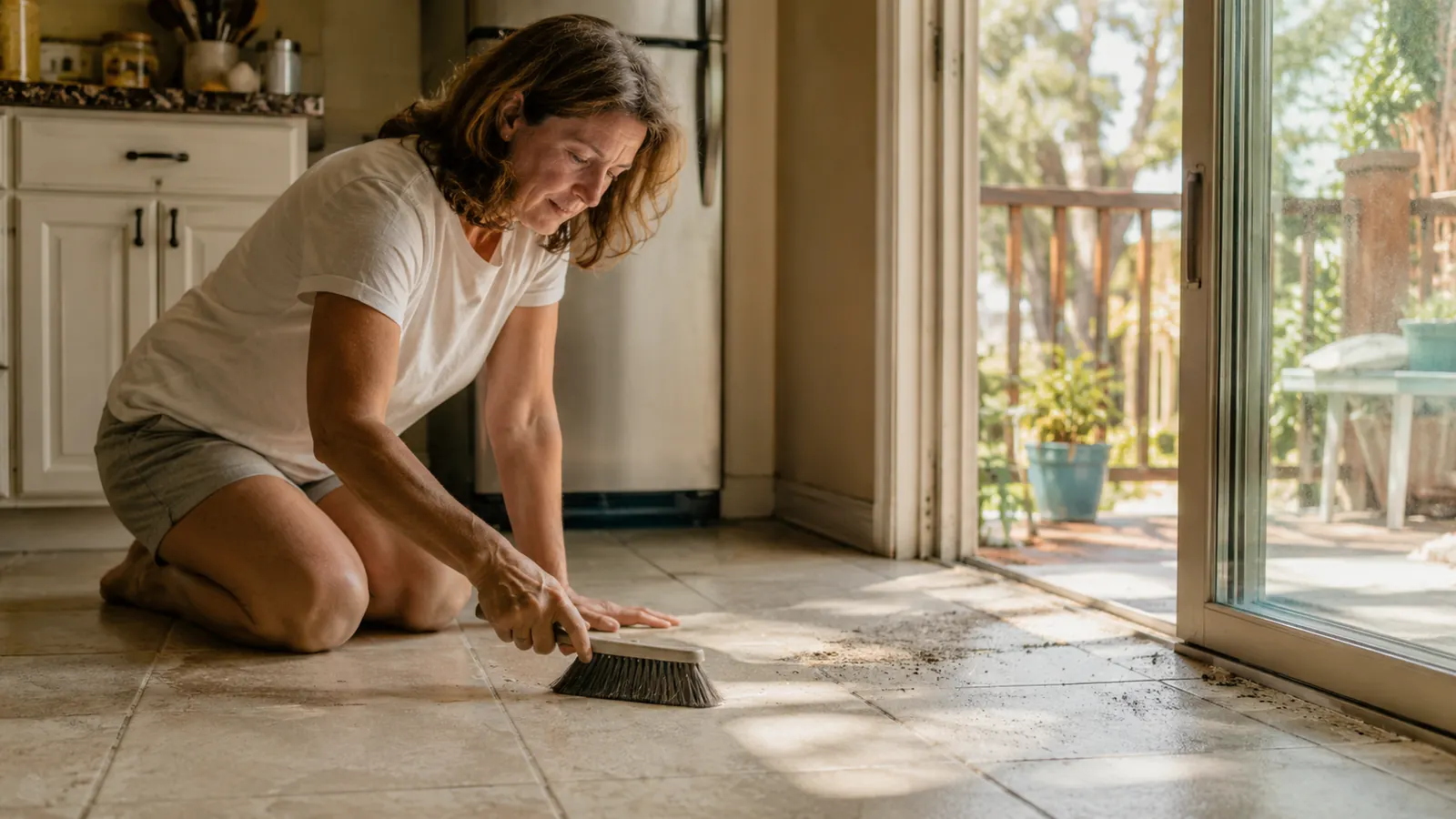
My kitchen floor is porcelain tile that runs straight out to a lanai, and from about May through September that sliding door might as well not have a threshold. Sand walks in on flip-flops, oak pollen dusts every flat surface by noon, and my lab mix Otis tracks in enough grass clippings after a yard patrol to reseed a lawn. For years I fought this with a broom and dustpan twice a day, which sounds virtuous until you do the math: two sweeps a day, every day, and the floor still looked gritty by four in the afternoon. What actually fixed it wasn't a different floor or a stricter shoes-off rule. It was building a five-minute routine around a plain, budget corded stick vacuum I almost talked myself out of buying: the Bissell Featherweight, the basic corded version, not some cordless flagship with an app and a charging dock.
The upright we had before this lived in the hall closet behind the vacuum bags and never came out until company was on the way, because dragging out a fifteen-pound machine for a five-minute crumb patrol never felt worth the effort. A stick vacuum only works as a real floor-care system if it is lighter and closer at hand than the broom, and that is the actual argument for switching, not that a spec sheet promises stronger suction than it used to. Below is the exact five-step routine I run now on tile and the vinyl plank in the hallway, plus where the Bissell Featherweight genuinely earns its keep and where I still reach for a mop instead.
None of this is about buying a fancier machine. It's about matching the effort to the mess, doing the right pass at the right frequency instead of one exhausting deep clean that gets skipped half the weeks it's due. That's the whole logic behind the five steps below, and it's the same logic that makes the difference between a floor that looks fine right after cleaning and one that actually stays that way.
The floor doesn't need a deep clean. It needs a machine you'll actually grab.
The Bissell Featherweight lives in the pantry, not the hall closet, because at under five pounds it's the one vacuum in the house nobody has to talk themselves into using. See today's price and current availability on Amazon.
Amazon Check Today's Price on Amazon →Step 1: Run a Two-Minute Pass After Dinner, Not a Weekly Deep Clean
The single biggest change wasn't the tool, it was the timing. I used to treat floor cleaning as a Saturday project, which meant six days of grit building up underfoot before anything got addressed. Now the Bissell Featherweight comes out right after dinner dishes are done, while the kitchen is already in cleanup mode. Two minutes, maybe three if Otis had a big day outside, and the crumbs, sand, and pollen dust from that day never get the chance to accumulate into a Saturday project in the first place.
This only works because the machine is light enough to not feel like a chore. At just under five pounds, the Bissell comes off its wall hook, plugs into the kitchen outlet, and covers the tile in under ninety seconds. I genuinely could not do this every single night with the old upright. Frequency beats intensity here, and frequency only happens if the tool doesn't fight you.
It also changes what a deep clean weekend actually involves. When the daily buildup never gets the chance to set in, the Saturday version of this routine is closer to fifteen minutes of mopping than the hour of sweeping, vacuuming, and scrubbing it used to take when the floor had a full week of neglect stacked up behind it.
Step 2: Work the Edges and Baseboards Before the Open Floor
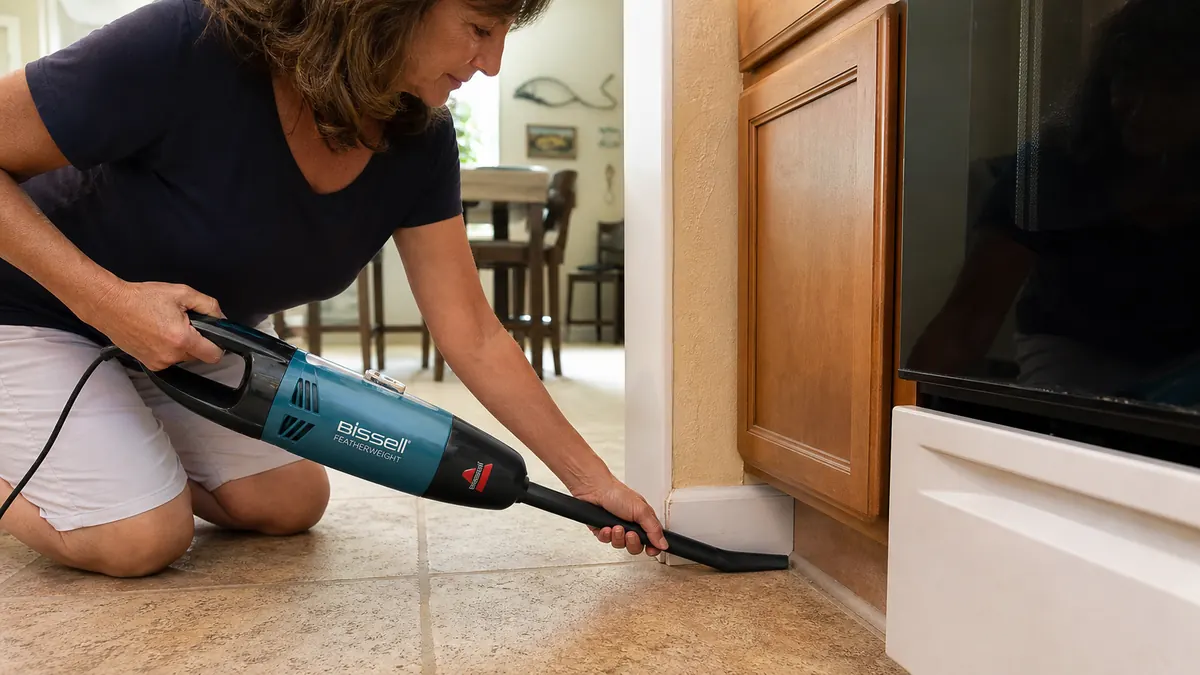
Most of what makes a floor look dirty isn't sitting in the open middle of the room, it's collected along the baseboards, in the corner by the pantry, and under the lip of the stove kickplate. A broom pushes that stuff around more than it collects it, and an upright's beater bar usually can't get flush enough to the wall to pull it out at all.
The Bissell Featherweight ships with a small crevice tool that snaps onto the hose, and I run that along every baseboard and corner before I ever touch the open floor with the main head. It takes maybe thirty extra seconds and it's the step that actually explains why the room looks cleaner afterward, not just the middle of the floor where feet walk.
Do the edges last and you'll notice dust resettling onto a floor you just vacuumed. Do them first and the open-floor pass at the end is the one that actually finishes the job. I also run the crevice tool along the base of the kitchen island cabinets, where crumbs collect and nobody thinks to check until they're stepping on grit in bare feet.
Step 3: Plan Your Route Around the Cord Instead of Fighting It
Here's the honest tradeoff: the Bissell Featherweight is corded, and that means you're not walking it cordlessly from the kitchen to the bedroom hallway and back without a plan. I'm not going to pretend that's nothing. If you're picturing a cordless stick vacuum you glide room to room with, this isn't that machine, and it never claims to be.
What it does buy you is full power the entire time, no battery meter creeping down mid-pass, no mid-clean charging wait. I start at the outlet closest to the far end of the run, usually the pantry plug, and work backward in loops toward the kitchen island so the cord trails behind me instead of crossing back over ground I've already cleaned. A short extension cord lives in the utility drawer for the hallway and the vinyl plank near the laundry room, since that run is just out of reach of the kitchen outlets.
It's also worth saying plainly that this machine is built for hard floors and light carpet, not a deep wall-to-wall rug. On the small bath mats it does fine for surface crumbs. On the living room area rug it moves things around more than it lifts them out, and I don't ask it to try. Knowing that upfront saves you from expecting carpet performance out of a floor tool and calling it a letdown when it doesn't deliver that.
Step 4: Empty the Bin and Rinse the Filter Every Week, Not When It Starts Whining
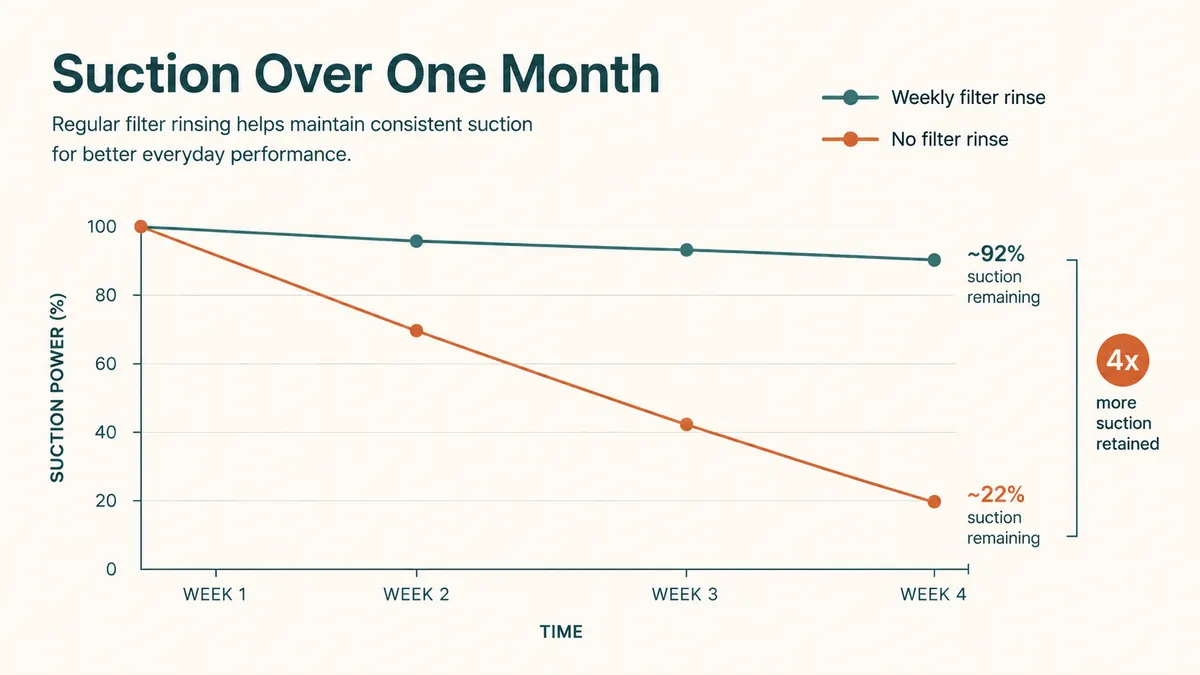
The bagless cup on the Bissell Featherweight is small, which is part of why the whole unit stays light, but it also means it fills faster than you'd expect from a household this size. I empty it after every use, which takes about ten seconds over the kitchen trash can, and it keeps the suction from dropping off mid-pass on day three of a full bin.
The filter is the part people skip, and it's the part that actually determines whether this thing still pulls sand out of grout lines six months from now. Once a week I pull the filter, rinse it under the sink until the water runs clear, and let it air dry a full day before it goes back in. Reinstall it wet and you're just packing damp dust into the intake, which is a fast way to make a budget machine feel underpowered when the real problem is maintenance, not the motor.
Once a month I also check the brush roll for wrapped hair and thread, mine and Otis's both. A pair of scissors and two minutes handles it. Skip this for a season and you'll notice the head stops spinning as freely against tile, which reads as weak suction even when the motor is fine. I keep a small pair of curved scissors clipped right to the charging hook so there's no excuse to skip this step.
Step 5: Follow With a Damp Mop Where Grease or Ground-In Grit Builds Up
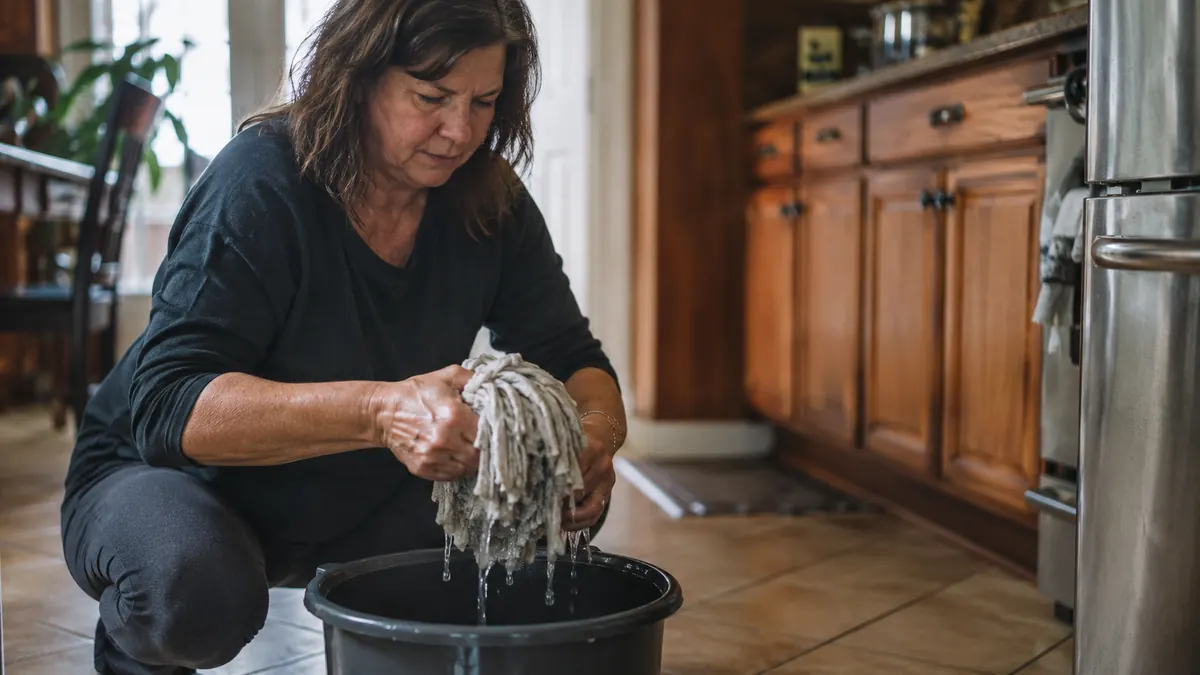
No stick vacuum, budget or otherwise, lifts a greasy film off tile near the stove, and I want to be straight about that instead of overselling what the Bissell can do. It's built to pull up dry debris, crumbs, sand, pet hair, pollen dust, and it does that job well for what it costs. It is not a mopping substitute, and sand that's been ground into grout lines by foot traffic for a week needs more than suction to lift out.
So the routine ends with a real mop pass, once a week for the whole kitchen and hallway, more often right around the stove where cooking grease settles. I do the vacuum step first every time, because mopping over crumbs just turns them into paste in the grout lines, and a floor that's already been vacuumed daily needs a much lighter mop pass than one that hasn't.
Together the two steps cover what either one misses on its own. The Bissell handles the daily dry mess before it accumulates, and the weekly mop handles what only water and a cleaner can actually lift. Neither one is trying to do the other's job, which is honestly why the combination works better than expecting one machine to do everything.
What Else Helps
A good doormat, inside and out, catches more sand before it ever hits the tile than any vacuum catches after the fact. I keep a coarse outdoor mat by the lanai door and a washable indoor one just past it, and between the two, Otis tracks in noticeably less than he did before we had either. If you're weighing whether a stick vacuum is worth adding to a floor routine at all, it's worth reading 10 Reasons a Stick Vacuum Beats Dragging Out the Upright first, since it lays out the case beyond just this one machine. And if you want the fuller picture on where the Bissell Featherweight actually struggles before you buy one, I go into that in more detail in the Bissell Featherweight honest review.
Humidity plays a bigger role in a Florida house than most cleaning routines account for. Damp mopped floors take longer to fully dry when the air itself is heavy with moisture, so I run a ceiling fan or crack a window for ten minutes after mopping rather than letting the floor air dry on its own. It also means grit that would just sit and dry elsewhere tends to stick and smear here, which is one more reason the daily vacuum pass matters more in this climate than it would somewhere drier.
The floor doesn't get clean because the machine is powerful. It gets clean because the machine is light enough that you actually use it every day.
A five-minute habit beats a Saturday project every time.
If your floor routine currently depends on motivation instead of a light, grab-and-go machine, the Bissell Featherweight is the fix. Check today's price on Amazon and see if it's still in stock.
Amazon Check Today's Price on Amazon →